
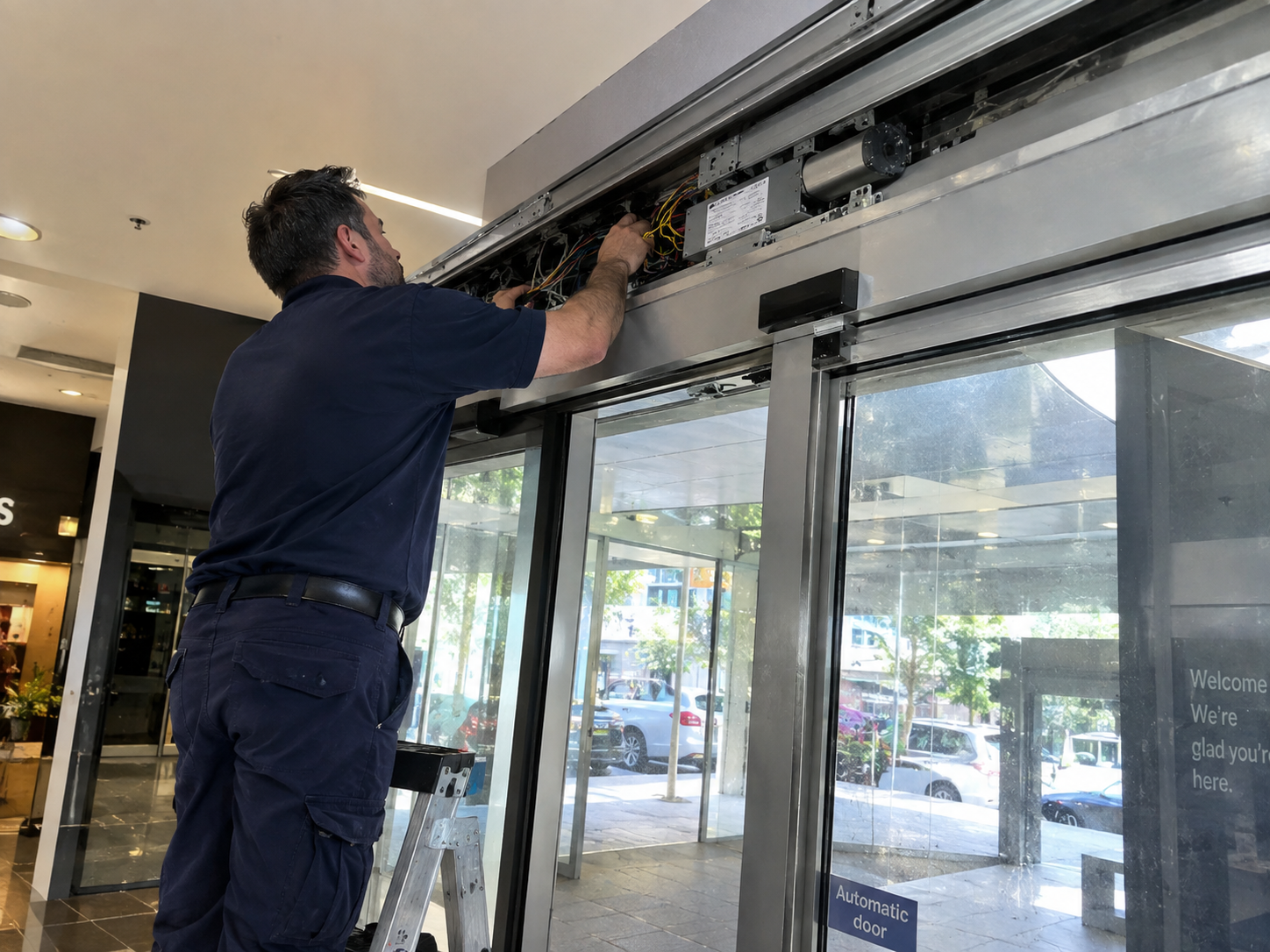
Your automatic sliding door failed to close last night. Your shopfront is wide open, stock is exposed, and your alarm company won’t stop calling.
You search for automatic door repair near me, and every result tells you something different. Fix it, replace it, or upgrade the whole thing. The conflicting advice makes a stressful morning even worse.
The truth is simpler than most people make it. Whether your entrance is a basic glass door or a framed or frameless sliding system, the repair-or-replace decision comes down to a few clear factors, and getting it wrong is what actually drains your budget.
Key Takeaways
- Most automatic sliding door repair jobs fix the problem for years when the operator is under ten years old.
- Repeated motor and sensor faults signal that automatic door replacement may save you long-term headaches.
- Safety beam faults and closing force issues both demand immediate technician assessment under Australian Standards.
- Downtime from business interruption often costs more than the repair itself.
Common Faults Worth Fixing
Not every breakdown means you need a new door. Many commercial automatic door repair calls involve simple component repair jobs. A worn drive belt, a dirty sensor, or track misalignment can cause intermittent operation that looks far worse than it actually is.
Quick-Fix Component Failures
- A dead battery in the activation device often causes slow opening that mimics motor failure.
- Worn rollers create grinding noise along the track but cost little to swap out.
- A faulty control board can cause false activation, yet the rest of the door system stays perfectly healthy.
These fixes restore your pedestrian door to full function within hours.
When Repair Becomes a Money Pit
You call for automatic sliding door repair three times in six months. Each visit patches a different fault. The operator shows overheating one week. The next month, the controller throws error codes. By month six, your total repair cost exceeds what a retrofit would have required.
The tipping point hits when parts availability dries up. Older telescopic door models and legacy bi-parting door systems often use discontinued components. Your technician cannibalises parts from other jobs just to keep your glass door running. That is not a strategy. That is a countdown.
The Safety Risk You Cannot Ignore
Aging door systems carry real entrapment risk. When the closing force exceeds safe limits, or the safety beam loses coverage, someone can get hurt. This is not theoretical. It happens in busy commercial premises every single year.
Australian Standards under AS 5007 require specific sensor coverage and emergency egress performance. If your door fails a safety inspection, no amount of patchwork fixes will bring it into compliance. A technician assessment will tell you fast whether your system meets current rules or needs modernisation to protect accessibility and tenant safety.
Repair vs Replacement at a Glance
| Factor | Repair | Replacement |
| Door age under 10 years | Usually the right call | Overkill for minor faults |
| Door age over 15 years | Temporary fix at best | Smarter long-term move |
| Repair history | Clean record favours repair | Frequent breakdowns favour replacement |
| Traffic volume | Low traffic suits repair | High traffic demands reliability |
| Warranty | Parts-only coverage | Full system warranty |
| Replacement cost impact | Low upfront outlay | Higher upfront, lower long-term |
What the Data Tells Us
Industry data shows roughly 40% of automatic door failures trace back to sensor and safety beam issues, not motor breakdowns. (Source)
This means most automatic sliding door not closing problems and automatic door sensor not working faults start with a dirty lens or a misaligned bracket, not a dead motor. Knowing this simple fact saves you from authorising unnecessary operator replacement jobs.
When Even a Good Repair Fails
Repairs are the right call most of the time, but your location matters. A new motor installed in a coastal shopfront may wear out faster due to salt air and humidity. This does not mean the repair was wasted. It means your environment demands a tougher long-term plan, like a modernisation or operator replacement, sooner than an inland building would.
Do not let anyone rush you into a full rebuild when a retrofit solves the problem. If your glass door frame is solid, upgrading the operator, sensors, and safety beams often delivers the same reliability at a fraction of the effort. Always get a second technician’s opinion before committing to a complete door replacement.
Conclusion
The right call between automatic sliding door repair and automatic door replacement comes down to door age, repair history, and safety compliance. Stop throwing money at recurring faults and start making decisions based on real data from your technician.
First, book a full safety inspection to check sensor coverage, closing force, and emergency egress. Second, ask your technician for a written breakdown of parts availability for your specific model. Third, compare the total downtime cost of repeated repairs against a one-time modernisation.
Your customer access, security, and energy loss numbers will thank you for acting early. Visit Auto Ingress for expert guidance on commercial automatic door repair and automatic door repair Melbourne solutions tailored to your premises.
FAQs
1. Why does my automatic door keep opening by itself?
Dirty or misaligned sensors are triggering false openings. Wipe dust, bugs, or webs off the sensor lens. If the door still ghost-opens, a technician must recalibrate or replace the sensor.
2. How long does an automatic sliding door last?
15 to 20 years with proper maintenance. The internal motor and controller usually need replacement around year 10. High foot traffic and harsh outdoor weather will shorten this lifespan.
3. Can I reset my automatic door myself?
Yes, by power cycling the main switch. Turn the power off for 30 seconds, then turn it back on to clear software glitches. If errors return immediately, you have a broken hardware part.
4. Is a noisy automatic door dangerous?
Yes, grinding noises can lead to sudden door jams and entrapment. Squeaking or grinding means worn rollers or misaligned tracks. Left unfixed, the door can derail and block your emergency exit.
5. Do automatic doors need yearly servicing?
Yes, annual servicing is required under safety standards. A technician must inspect sensor coverage, closing force, and backup batteries once a year to prevent injuries and keep your building compliant.